Connected Device Quality Engineering
Protocol Automation for Connected Devices
How to validate communication, product behaviour and recovery across wireless and serial interfaces.
Protocol Automation vs. Protocol Testing vs. End-to-End Connected Device Testing
- Protocol testing checks whether a specific interface follows its expected communication rules, such as BLE discovery and GATT behaviour, MQTT topics and payloads, UART framing, or Modbus register access.
- Protocol automation makes those checks repeatable by controlling setup, sending commands, capturing traces, asserting timing and state, injecting faults, and publishing evidence for every run.
- End-to-end connected device testing follows one product action across the protocol path and verifies the resulting physical, application, API or cloud state, including recovery after interruption.
The problem begins where a protocol test ends
A sensor can acknowledge a command, a gateway can publish a message and an app can show a success toast while the actual product state is wrong. Connected products translate intent across several links, and a local handshake proves only one part of that chain.
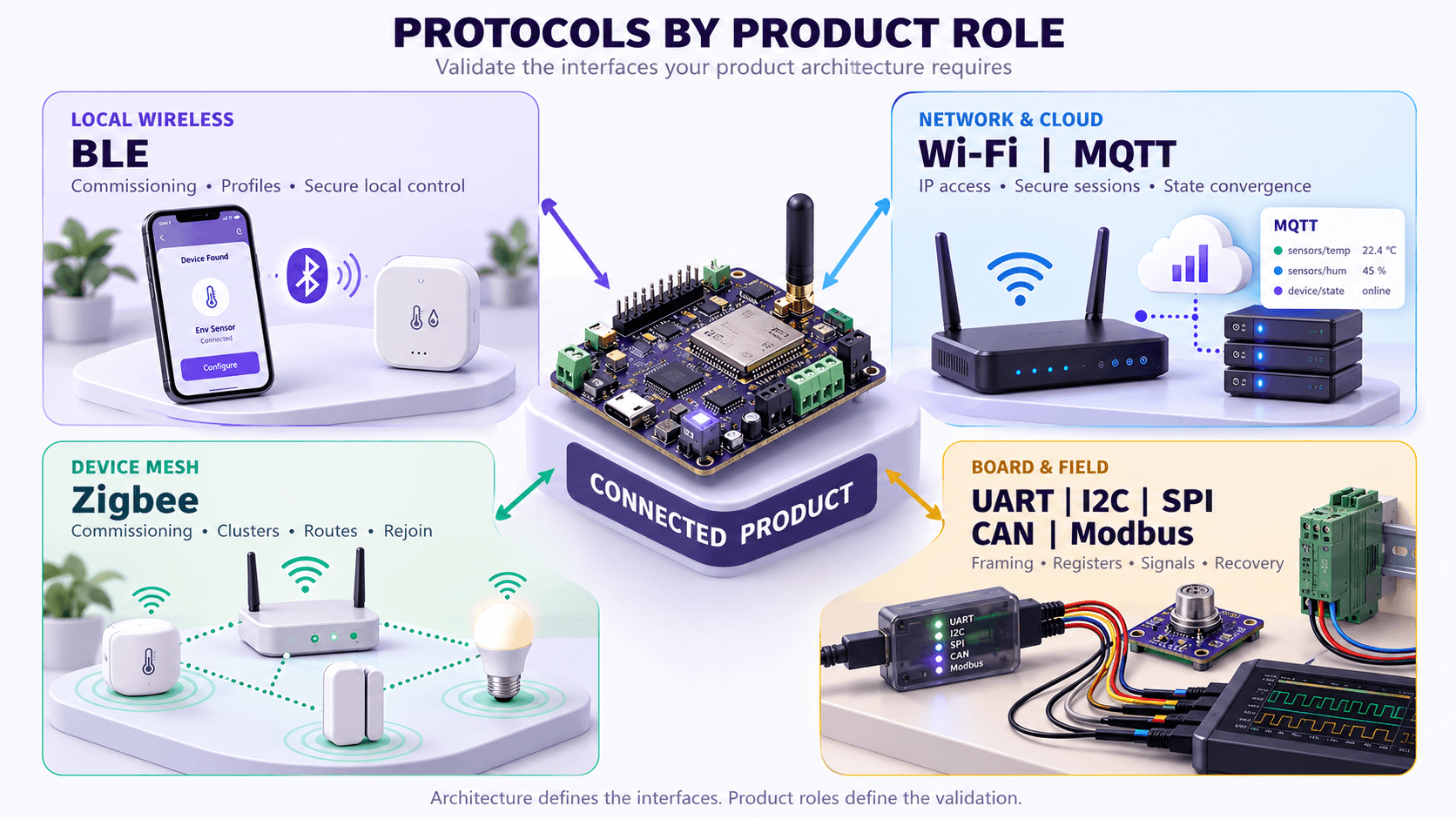
BLE pairing, Wi-Fi association, MQTT messaging, Zigbee mesh traffic, UART diagnostics, I2C sensors, SPI peripherals, CAN bus controllers and Modbus equipment each have their own timing, addressing and error semantics. Protocol automation should therefore capture both the wire-level exchange and the customer-visible outcome, with enough evidence to locate the failing boundary.
Start with a contract for each interface
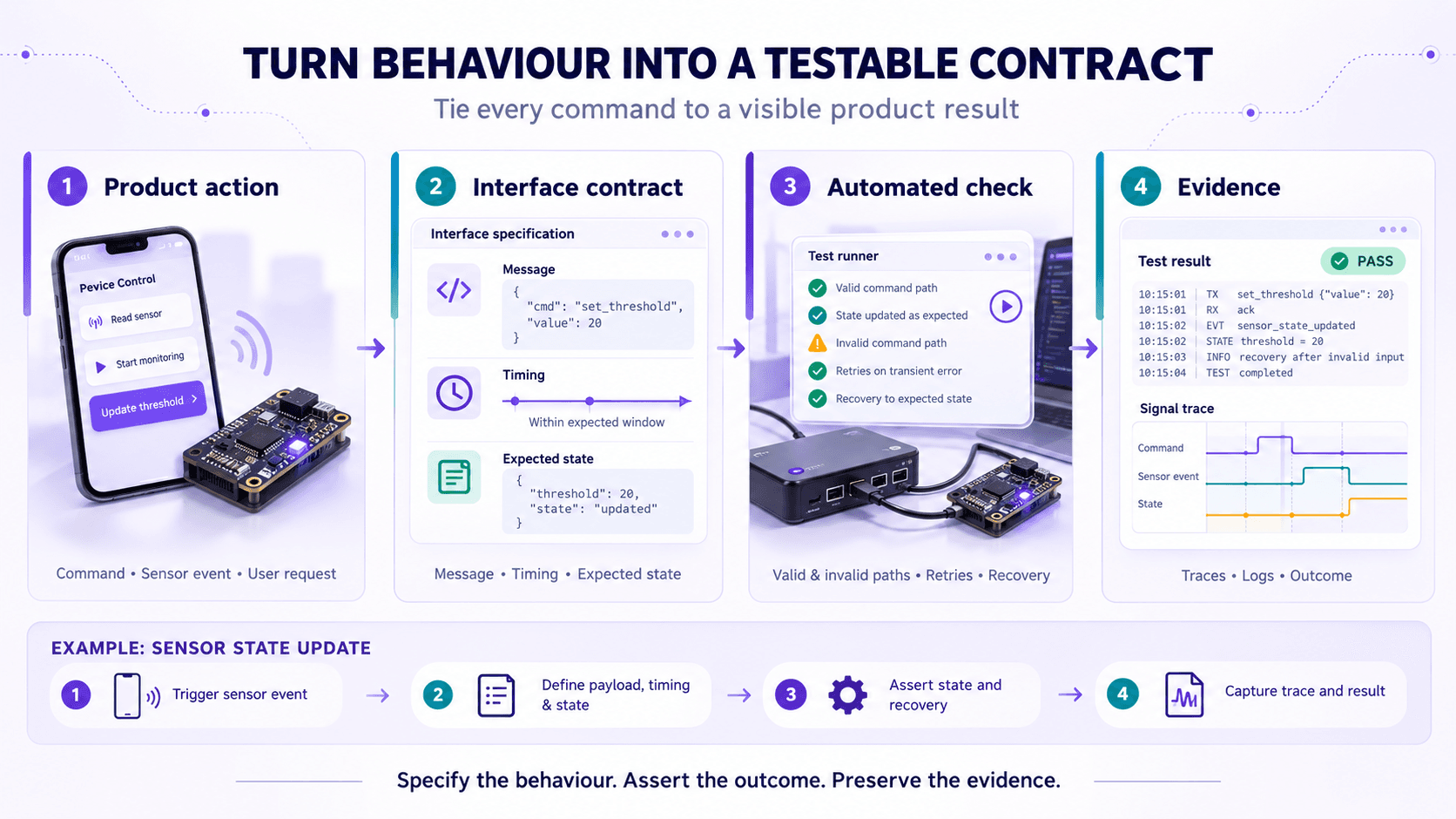
Before automating a protocol, describe the behaviour the product expects from it: endpoints, identifiers, message schema, units and byte order, command permissions, timing limits, retry policy, failure response and recovery state.
The contract also identifies where an observation can be collected: packet capture, bus trace, device log, gateway log, API response, cloud event or app state.
Every run should record build and firmware versions, hardware revision, interface configuration, topology, environment conditions and timestamps.
Wireless links need more than a successful connection
Wireless tests must include discovery, identity, secure access, data exchange, interruption and reconnection.
Signal strength, channel congestion, access point changes, a sleeping phone or a restarting gateway can alter timing. A useful suite checks whether subscriptions, credentials and state are restored and whether queued work is replayed correctly.
BLE validation from GAP to product profile
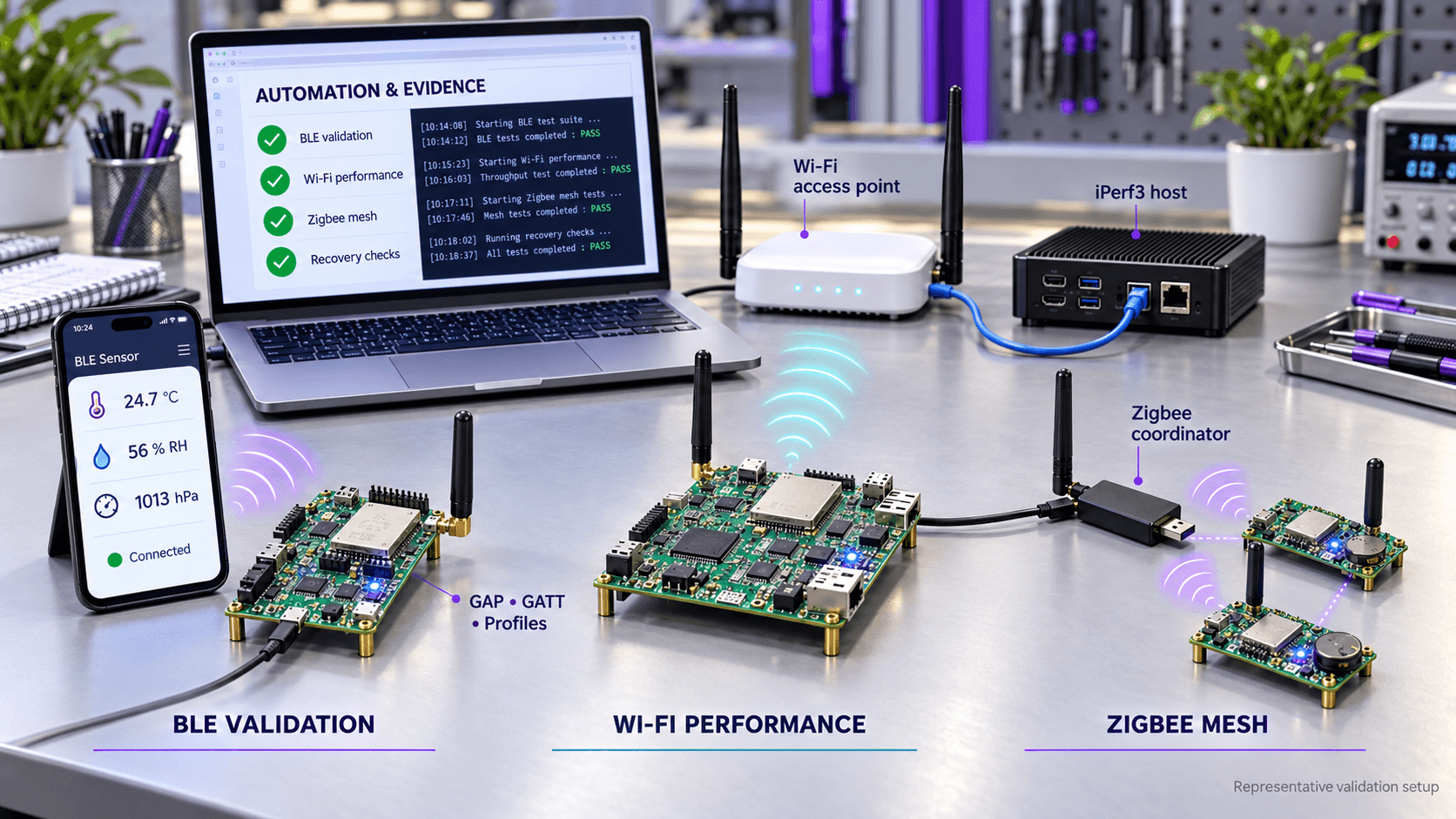
A BLE test strategy should separate GAP discovery and identity, connection and security, GATT/ATT data access, and the application profile carried by those services.
Passing a read of one characteristic is insufficient when the product depends on a particular advertising mode, negotiated connection behaviour, subscription state and profile-specific measurement format.
GAP discovery, identity and security
Validate advertising interval and mode, advertised service UUIDs, device identity, manufacturer data, scan response content and supported active or passive discovery.
For pairing and bonding, test authentication and encryption requirements, persistence across reset, reconnect with stored keys, bond removal and re-pairing.
Do not label a connection secure solely because pairing returned success; verify the protected operation and recorded security state.
Connection establishment and link behaviour
Measure discovery-to-connect latency, connection success rate, negotiated connection interval, peripheral latency and supervision timeout.
Run repeated connect and disconnect cycles, out-of-range loss, peripheral reset, application restart and reconnect after sleep.
A reconnect is complete only after security, service state and subscriptions required by the user journey have been restored.
GATT and ATT transaction validation
Discover expected services, characteristic UUIDs, properties, handles and descriptors, and verify mandatory versus optional attributes for the supported firmware version.
Exercise reads, writes, notifications and indications according to supported properties and validate boundary lengths, encoding, ATT errors and changed GATT databases.
Capture HCI or over-the-air traces alongside peripheral logs and app events to locate failures across the radio, GATT client, parser and UI.
Profile conformance and application meaning
A standardized BLE profile adds rules beyond the generic GATT database, including required characteristics, feature flags, data layout, units and optional-field conditions.
At the product layer, compare decoded values with controlled stimuli or reference instruments and confirm that mobile and cloud systems preserve units, identity, freshness and ordering.
Wi-Fi and MQTT validate network and message state
Wi-Fi validation should cover provisioning, authentication, address assignment, service reachability, reconnection, network switching and recovery from invalid credentials or unavailable services.
For MQTT, validate topics, authorization, payload schema, publish/subscribe flow, QoS behaviour, retained state, session continuity and duplicate handling.
After interruption, verify the intended offline queue policy, replay order and eventual device-cloud state convergence.
Measure Wi-Fi performance under controlled conditions
Start from the product's real tasks, such as sending sensor readings, responding to commands, streaming audio or downloading an update.
iPerf3 can measure throughput when traffic actually passes through the device. Repeat tests at realistic locations and network loads while recording signal conditions, drops and reconnects.
Throughput alone is not sufficient; real product actions must still complete promptly and recover reliably.
Zigbee validates commissioning and mesh behaviour
Cover joining and rejoining, endpoint and cluster discovery, commands, attribute reports, binding or groups where used, and route changes through a mesh.
Test coordinator or router loss and power restoration with the supported topology and verify that application-visible state remains fresh.
What Protocol Automation Should Validate Across Connected Devices
- BLE: discovery, identity, pairing and bonding, GATT/ATT access, notifications or indications, reconnect behaviour and profile meaning.
- Wi-Fi: provisioning, authentication, service reachability, performance, network switching and recovery.
- MQTT: topics, authorization, payload schema, QoS, retained or queued state, duplicates, replay order and convergence.
- Zigbee: joining, clusters, attributes, mesh routing, node loss and application state freshness.
- UART and AT commands: framing, command deadlines, terminal responses, unsolicited events, parser resynchronization and restart recovery.
- I2C and SPI: addressing or chip select, timing, byte order, transaction integrity and peripheral readiness.
- CAN and Modbus: identifier or register mapping, freshness, exceptions, timeout handling, bus behaviour and final equipment state.
Board and field interfaces need their own error models
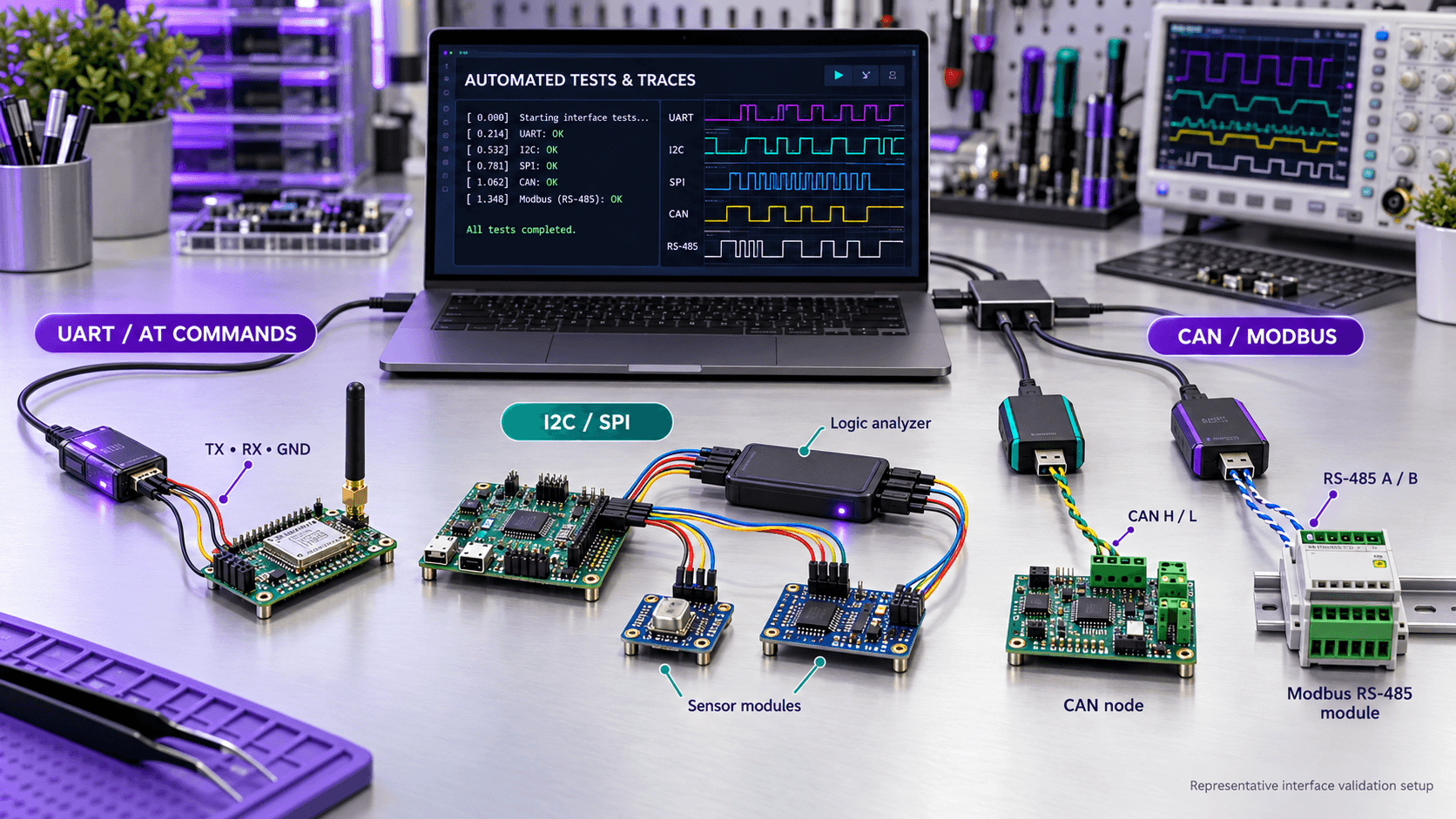
A reusable automation framework can expose a common test language while keeping electrical setup and protocol semantics in separate adapters.
A sensor register read, a full-duplex SPI transaction and a CAN frame must not be treated as equivalent simply because each returns bytes.
UART and AT command interfaces
For UART, verify baud rate, framing and flow control, command delimiters, echo policy, response parsing, unsolicited messages and timeout behaviour.
Exercise malformed commands, partial frames, burst traffic, reset during a transaction and port reopening. Preserve the raw byte stream alongside parsed results.
Automate BLE and Wi-Fi AT command workflows
An AT interface is a command and event stream, not a simple request-response function. The harness needs a serial transport layer, command scheduler and parser that separates echo, data lines, terminal responses, prompts and unsolicited result codes.
For Wi-Fi modules, validate responsiveness, firmware identity, station mode, access-point connection, addressing, sockets, data transfer and recovery from invalid credentials, DHCP, DNS, peer-close or network-loss conditions.
For BLE AT firmware, validate role initialization, scanning, peer connection, GATT discovery, reads, writes, subscriptions and reconnection behaviour.
I2C and SPI peripherals
For I2C, test addressing, register access, ACK/NACK handling, timeout, bus recovery and interpretation of multi-byte values.
For SPI, verify chip select, clock rate, polarity and phase, transaction length, byte order and duplex mode.
Compare sensor values against controlled physical or simulated stimuli rather than merely checking for nonempty responses.
CAN bus and Modbus equipment
For CAN, validate identifier filtering, payload decoding, periodic messages, command priority, timeout, stale-signal handling and recovery from relevant node or bus faults.
For Modbus, verify server selection, function code, register address, data type, scaling and byte or word order, and distinguish valid exception responses from timeout or corruption.
A register write should be confirmed with a subsequent read or independent equipment observation.
Realistic illustration
A passing MQTT publish, Wi-Fi transaction and local interface exchange can all appear green while the complete product still fails during recovery. Protocol automation therefore needs shared command identity, timestamps, raw traces and final-state assertions.
Build one end to end scenario from request to recovery
A connected environmental controller may receive a target temperature from a mobile app, pass it through an API and MQTT gateway, apply it locally, and confirm the result through an I2C sensor.
The test should follow one command ID through the entire journey and confirm that device, cloud and app state converge within the agreed time.
Interrupt Wi-Fi during the journey and verify whether the action occurred, whether retries are safe and whether duplicate actions are prevented.

Design a lab that makes faults repeatable
A controlled lab needs device identity and reservation, programmable power or reset, network control, protocol sniffers or bus analysers, safe sensor or actuator simulation and time-synchronized logs.
Fault injection should be deliberate and bounded. Examples include dropping packets, weakening connectivity, restarting a gateway, disconnecting a serial adapter, delaying responses or making a bus node unavailable.
Preserve first-failure artifacts before automated retries modify the system.
Controlled Validation Lab
Make faults repeatable in the lab
Control network, power and peripheral conditions while preserving evidence from every test run.
Power + I/O
Cycle power, drive inputs and reset devices.
Network Control
Control AP loss, signal conditions and reconnects.
Protocol Tools
Capture BLE, Wi-Fi, UART, CAN and bus evidence.
Device Under Test
Connected Product
Test Automation
Evidence
Fault Injection Scenarios
Connect protocol evidence to CI and release decisions
Fast parser, schema and adapter checks can run on relevant changes. Integration jobs can then exercise selected devices or simulators and affected protocol paths.
Scheduled suites cover longer wireless interruptions, mesh topologies, bus load and hardware variants, while release validation covers representative journeys, recovery and security boundaries.
Selection should remain traceable to changed components, requirements, prior defects and known risk.
Evidence to Release
Connect protocol evidence to release decisions
Every selected protocol and product test contributes traceable evidence to the final release decision.
01
Code Change
Identify affected product behaviour.
02
Select Tests
Choose protocol and product-level validation.
03
Run in Lab
Execute on devices, simulators and controlled faults.
04
Collect Proof
Preserve traces, logs, results and configuration.
05
Release Gate
Pass, review or stop based on evidence.
Evidence meets release policy.
Risk or missing evidence needs attention.
Critical release condition failed.
Release-ready evidence
Traceable build, known risk and auditable decision.
Glossary
- Protocol Automation — repeatable control, execution, fault injection, evidence capture and assertions for communication interfaces and product outcomes.
- Interface Contract — expected endpoints, message structure, timing, permissions, failure behaviour, recovery rules and completion state.
- GATT/ATT — the BLE data model and attribute protocol used to expose and access services, characteristics and descriptors.
- Correlation ID — an identifier tying one request to protocol events, device actions, logs and application or cloud state.
- Idempotency — application behaviour preventing a repeated command from causing an unintended duplicate action.
- Fault Injection — controlled introduction of failures such as packet loss, restart, timeout or unavailable nodes.
- State Convergence — when device, gateway, cloud and application views agree after communication or recovery.
Frequently Asked Questions
Is a successful connection enough to pass a protocol test?+
Should every protocol use the same test cases?+
How do we test unreliable wireless conditions?+
When should we use a simulator instead of real hardware?+
What is the minimum useful evidence for a failed run?+
Can iPerf3 prove that a device meets its Wi-Fi performance target?+
How should an AT parser handle unsolicited events?+
Can AI help with protocol automation?+
How do we avoid duplicate actions after reconnecting?+
What is protocol automation for connected devices?+
Which protocols can be automated in an embedded or IoT test lab?+
Talk to Elevro
Turn engineering complexity into a clearer path to release.
Have a product quality, automation, AI, embedded, cloud or release engineering challenge? Talk to Elevro about how we can help.
Talk to Elevro